Four Brothers from Hawes Street: The Eglons of Elswick and the Great War
Updated: Sep 20
The story of a coach painter's four sons, the gun-making streets of Elswick, and the war that took one of them
In Plot 3 of Tezze British Cemetery, a short way from the River Piave in north-east Italy, lies a Newcastle soldier who never came home. Lance Corporal Thomas Eglon of the 11th Battalion, Northumberland Fusiliers, died on 27 October 1918, aged 32. He was the eldest of four brothers who grew up in the same terraced house in Elswick, and all four of them served in the First World War.
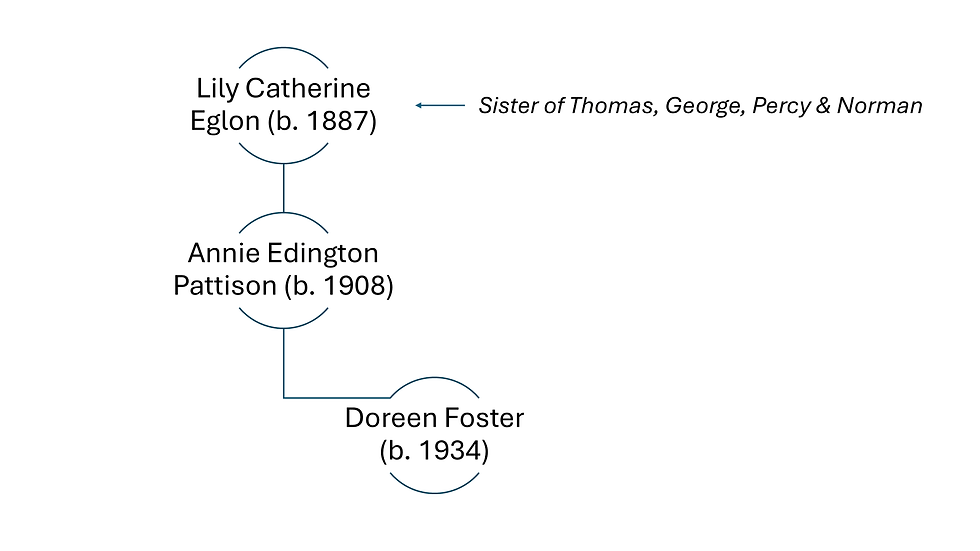
Thomas, George, Percy and Norman Eglon were the brothers of my 2x great-grandmother, Lily Catherine Eglon (born 1887), which makes them my 3x great-uncles. Lily married Harry Pattison, and their daughter Annie Edington Pattison (1908–1975) was given her grandmother's maiden name. What follows is an attempt to set the brothers' lives against the place that shaped them: the gun-making streets of west Newcastle, the jobs they took, the war that scattered them, and the quieter lives the three survivors made afterwards.
Elswick: a district built on guns
To understand the Eglons, you first have to understand Elswick. In the middle of the nineteenth century it was little more than fields and a few grand houses on the slopes above the Tyne. That changed in 1847, when William Armstrong opened an engineering works on the riverside, first building hydraulic cranes and then, from the late 1850s, guns. The works kept growing. It added a shipyard in the 1880s, merged with its rival Whitworth in 1897 to become Armstrong Whitworth, and by the time the Eglon children were growing up it was one of the largest armaments makers in the world, building guns, shells and warships for navies around the globe.
Thousands of workers needed homes, and street after street of terraces climbed the hill from the works. Much of Elswick was built as Tyneside flats, a type of housing found almost nowhere else: an upstairs and a downstairs home side by side, each behind its own front door. For families like the Eglons, the works set the rhythm of daily life. It was the district's biggest employer, the source of its noise and smoke, and, as it turned out, the reason war would come so close to home.
Hawes Street
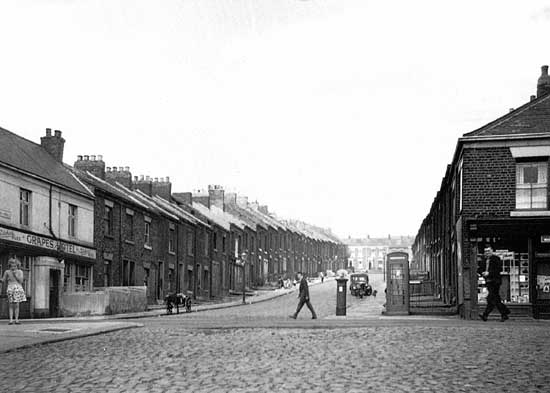
At the time of the 1891 census, the family lived at 19 Hawes Street, Elswick and by 1901 the family had moved along the street to number 25. Their father, George Eglon (1862–1948), was a coach painter. This was a skilled artisan trade: horse-drawn carriages, cabs and, increasingly, tram cars and railway carriages were built up with coat after coat of paint and varnish, each rubbed down by hand, then finished with fine lining and lettering. His wife, Annie Eglon, née Edington (1860–1943), ran the home and the children that appear in the 1901 census records are:
Thomas (born c.1886)
Lily Catherine (born 1887), my 2x great-grandmother
Alice Ethel (born c.1890)
George (born 1892)
Isabella (born 1895)
Percy John (born 1898 or 1899)
Norman (born 1900)
Records found elsewhere also confirm an additional daughter, Mabel Eglon, who lived between 1896-1898.
That makes eight children in fourteen years, four girls and four boys, which was a perfectly ordinary family size for Elswick at the turn of the century. With parents and multiple children under one roof, the house on Hawes Street must have been full to bursting.
The 1901 census finds the family at the Hawes Street address. Thomas, aged just 15, was already working, as a labourer in a shot factory. "Shot" meant shells and projectiles, and with Armstrong Whitworth's works at the bottom of the hill, he was almost certainly making ammunition for the company. A boy of 15 in full-time work was nothing unusual. Since 1899 the law had required children to stay at school only until 12, and most working-class boys went out to earn as soon as they could.
By the 1911 census, the house had thinned out. Lily had married Harry Pattison and had children of her own (including my direct ancestor, Annie), and Thomas, now about 25, had married Annie Mooney in the first quarter of that year, their son John Thomas had been born in the previous November. George, 19, was working as a bricklayer, a good trade in a city still building terraces as fast as it could fill them. Percy, 13, and Norman, 11, were still at school.
Thomas: from the shot factory to the Piave
Lance Corporal Thomas Eglon, service number 46792, enlisted in 1903 at the age of 17 and by 1918 served with the 11th Battalion, Northumberland Fusiliers. In his early military years, he appears to have been a Durham Light Infantry soldier. His later regiment, the Northumberland Fusiliers were the county regiment, the old 5th Regiment of Foot, known to generations of Tynesiders as the "Fighting Fifth". The war turned it into a giant. It grew from 7 battalions to 52, the second-largest infantry regiment in the British Army, and more than 16,000 of its men were killed.
The 11th (Service) Battalion was one of the "Kitchener" battalions, raised in Newcastle on 22 September 1914 from the flood of volunteers who answered Lord Kitchener's call. It joined the 68th Brigade of the 23rd Division, crossed to France in August 1915, and in November 1917 was sent to Italy to help shore up the Italian front after a disastrous defeat.
Records from WW1 indicate that Thomas served as a private (26/211) from December 1914. He was then discharged due to gunshot in July 1917, before rejoining and serving as a Lance Corporal in the 11th Battalion.
During this timeline, 1914 births and deaths records indicate that Thomas and his wife, Annie, lost a newborn child, Margaret. Sadly, Annie died three years later at the end of 1917. Their son, John Thomas, was raised by his paternal grandparents.
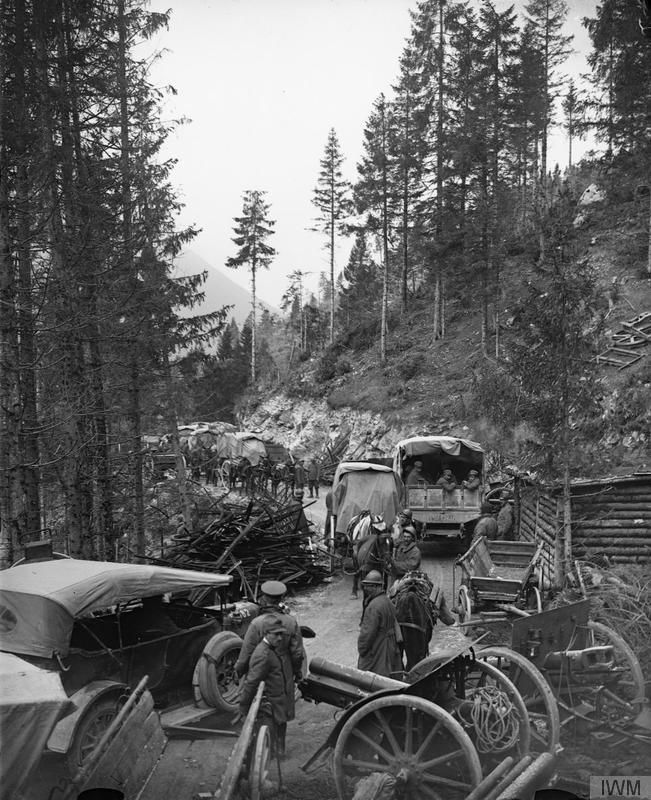
Italy was no easy posting and in June 1918, the Austro-Hungarian army attacked the British line on the Asiago Plateau (a place I visited in 2009 before knowing this family connection).
The crossing of the Piave
The battalion's last great battle was Vittorio Veneto, the offensive that finally broke the Austro-Hungarian army. The first obstacle was the River Piave, nearly a mile wide and swollen after days of rain. On the night of 26 October, the men crossed to the Papadopoli islands in the middle of the river, one at a time over a narrow plank walkway laid across a line of small boats, with Italian boatmen spacing them out so the bridge wasn't overloaded. Shrapnel burst in the darkness above them. At dawn on 27 October, they went over the main channel and attacked the far bank. Most of the Austrian defenders fell back after a heavy British bombardment. The Italian bridges further upstream had been swept away or destroyed, so the British divisions found themselves leading the advance.
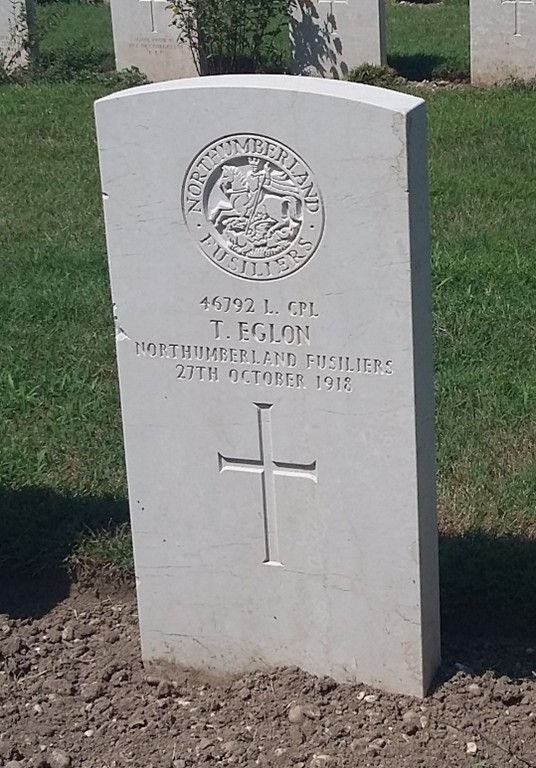
Thomas sadly died that day. Austria-Hungary signed an armistice just eight days later, on 4 November, and the guns on the Western Front fell silent a week after that.
The news reaches Hawes Street
News of Thomas most likely came as a printed War Office form letter, Army Form B.104-82, with Thomas's details written in by hand. It probably arrived in November, so the family would have been grieving just as the rest of Newcastle took to the streets to celebrate the Armistice. Later would come his few personal effects, any back pay and his war gratuity, and eventually his medals, the British War Medal and Victory Medal.
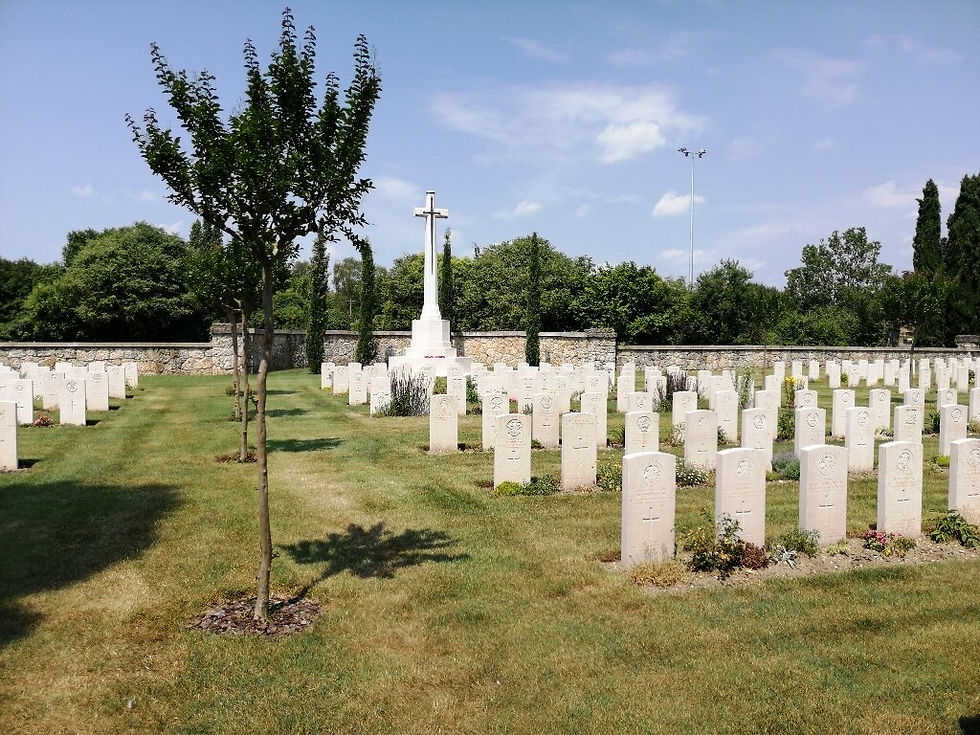
Thomas is buried in Plot 3 of Tezze British Cemetery, near the river he crossed on the last day of his life. A bio is featured on the North East War Memorials Project website.
George: the bricklayer/cartman who became a signaller
George Eglon, named after his father, was born in 1892. The 1911 census, taken when he was 19, finds him living at home and working as a bricklayer.
In 1916, George married Mary O'Gorman. Her surname points to Irish roots, which would have been nothing unusual in Elswick, where many families were Irish Catholics drawn to Tyneside by work. Their son, Percival, was born in February 1917, and was quite possibly named after George's younger brother Percy. Army records also report an older son, George O'Gorman, born in July 1915 before their marriage. So when George went into the army, he left behind a young wife and two boys at home.
George's army records date to 1917, he enlisted in July of that year, but was discharged by September, deemed physically unfit due to a condition had since youth - Keratitis (inflammation of the cornea). The army records also reveal details of his appearance: he had dark hair, a dark complexion and his height was just 5ft 4inches. At the time of enlistment he worked as a cartman and lived at 22 Panmure Street, so still in the Elswick area.
For the short time he served, George was in the Royal Engineers, with service number 316515. His unit is recorded as "SD Bedford", which almost certainly means the Royal Engineers Signal Service depot at Bedford, where signallers were trained. The Signal Service kept the army talking. Its men laid and repaired telephone and telegraph cable, sent messages by Morse, lamp and flag, worked the early wireless sets, and ran the despatch riders who carried messages by motorcycle. It was technical, often dangerous work.
George's service record survives, and that alone makes it special. It is part of series WO 363, the so-called "burnt documents". In September 1940, a German bombing raid set fire to the War Office record store in London, and roughly 60% of the service records of First World War soldiers were destroyed. Many of those that survived are singed and water-stained, so George's file is among the lucky ones.
Percy: from the barrow to the Flying Corps
Percy John Eglon was born in circa 1898/1899 and was still at school at the time of the 1911 census, aged about 13. When he next appears in the records, in 1917, he was working as a hawker.
Hawkers were the street traders of the Victorian and Edwardian city, selling fruit and vegetables, fish, firewood, crockery, or anything else that could be carried in a basket or wheeled round on a barrow. It was hard, outdoor, hand-to-mouth work, and it took a quick tongue and a thick skin. Around Newcastle's markets and the terraced streets of the west end, the hawker's cry was part of the everyday soundscape. It seems to have become something of a family trade, because Norman would later make his living the same way.
On 14 November 1917, aged about 19, Percy enlisted with service number 109527. There was no Royal Air Force yet, so he joined the Royal Flying Corps, the army's air arm. On 1 April 1918, the RFC merged with the Royal Naval Air Service to form the RAF, the world's first independent air force, and Percy became one of its first airmen. Most airmen never flew. They were the ground crew who kept the fragile wood-and-canvas aircraft in the air: riggers, fitters, drivers, storemen and clerks.
Percy's service record survives in the Air Ministry's airmen's records (AIR 79/982) at The National Archives and shows that his role was as a Batman, an airman assigned to a commissioned officer as a personal servant.
Percy in 1939
Percy came home from the war, and the 1939 Register finds him as Percival Eglon, the full name that "Percy" was short for, living at 28 Herbert Street, Newcastle. It gives his birth date as 18 June 1899, which doesn't quite match his RAF record: that gave his age as 19 in November 1917, which would put his birth in 1898. I beleive the RAF record is a year out.
By 1939 Percy had left the barrow behind. He was working as a driller, a job in heavy engineering and shipbuilding, where drillers bored the holes in steel plates and frames ready for the riveters. With Tyneside's yards and works gearing up for rearmament, it was steady work. He also had a civilian role in Air Raid Precautions (ARP).
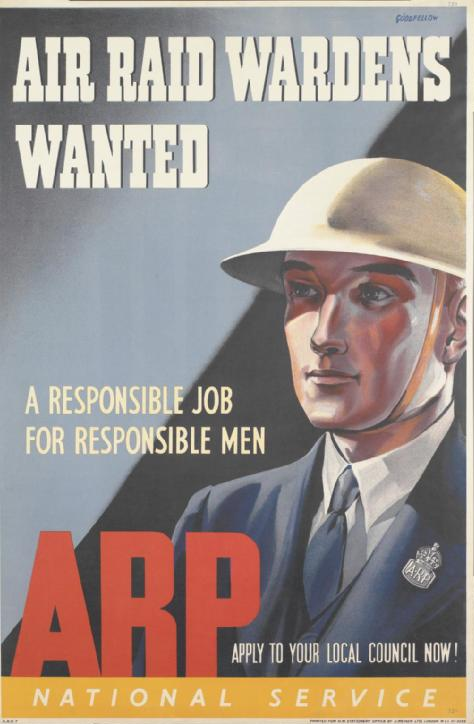
In the weeks after war broke out, hundreds of thousands of volunteers across Britain signed up as wardens, fire-watchers, first-aiders and rescue workers, and Tyneside's shipyards and factories made it an obvious target for German bombers. Twenty years after he joined the Flying Corps, Percy was fitting sandbags and watching the skies again, this time from the streets of Newcastle.
His wife, Beatrice Lily Bower, born on 1 January 1905, is recorded as doing "Unpaid Domestic Duties". There's an interesting detail in her entry. Her surname is written "Young (Eglon)". The 1939 Register was a living record, kept up to date for identity cards and rationing and later for the NHS, and a woman's change of name on marriage was the commonest amendment of all. So the entry tells us that Beatrice later remarried, to a Mr Young, after Percy's death - which is true, marriage records confirm that she married a William Young three years after losing Percy. The two other members of the 1939 household have closed records, which usually means people born less than 100 years ago with no recorded death. They were most likely Percy and Beatrice's children.
Percy died in 1946, in his late forties. His mother Annie had died three years before him.
Norman: the youngest, and a silver badge
Norman Eglon, the youngest of the family, was born in Newcastle in 1900 and was still at school during the time of the 1911 census. A few years later, whilst working as a gun machinist, he enlisted on 4 April 1918, less than six months before Thomas was killed. By then he would have known his three older brothers were all in uniform.
A boy soldier's training
By 1918, the army had learned not to throw its youngest recruits straight into battle. Under a system introduced in 1917, lads of 18 years and one month went first to a Young Soldier battalion for basic training, then to a linked Graduated battalion to be built up before being sent anywhere near the front. Norman's records follow that route exactly. He joined through the Training Reserve with the number TR/171355 and passed through the 53rd (Young Soldier) and 51st (Graduated) battalions. He was later posted to the 3rd Battalion, Durham Light Infantry, with a new number, 114399.
Norman never served overseas. The war ended while he was still in training in Britain, and on 4 July 1919 he was discharged under King's Regulations paragraph 392 (xvi), "no longer physically fit for war service". His original record confirms that this was due to deficient eyesight. I haven't been able to identify the condition, so it's unclear whether it was similar to George's.
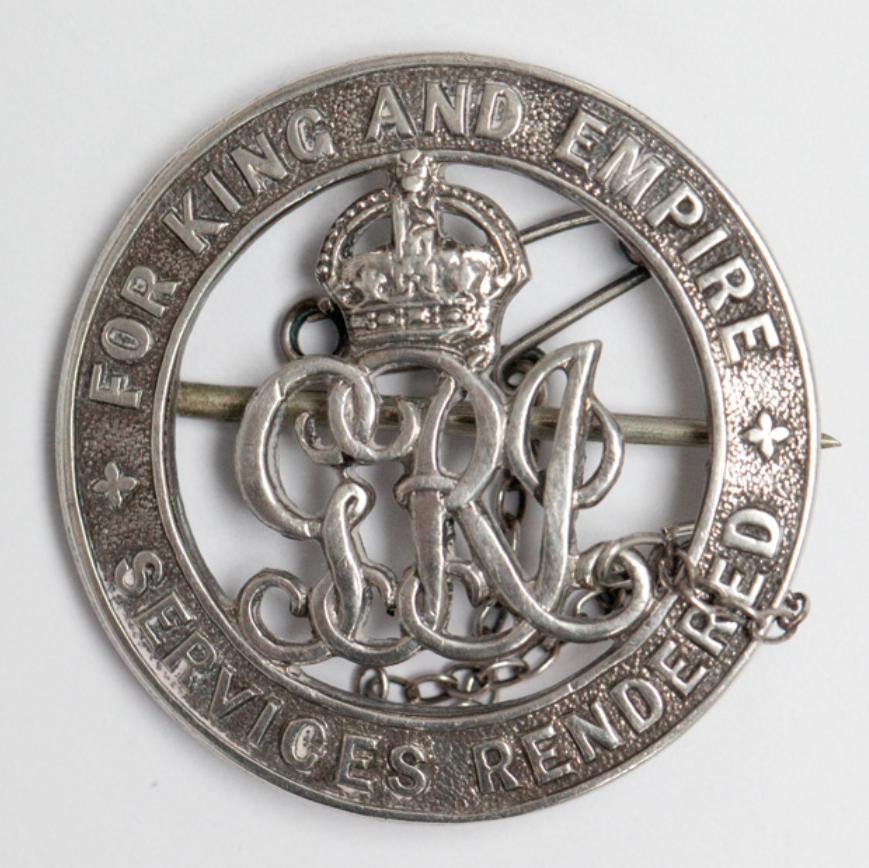
The Silver War Badge
Because he was discharged on medical grounds, Norman was awarded the Silver War Badge, number B293942, issued on 20 September 1919. The badge was introduced in 1916 for a very human reason. Men who had been invalided out of the forces were being accused in the street of shirking, and some were handed white feathers as a mark of cowardice. A small silver badge pinned to their civilian lapel showed that they had done their bit. Norman's medal index card (WO 372/6) records this badge. George likely received one too.
A family of his own
Norman married Margaret, and they had two children: Norman, born in January 1922, and Noreen, born in February 1924. The 1939 Register, taken on 29 September 1939, just after the start of the Second World War, finds the family at 21 Front Hawes Street, close to the house where Norman grew up. He was working as a hawker, as Percy had. Norman died in 1949, aged about 49, a year after his father.
Three came home
The Eglons were luckier than many Elswick families. Three of the four brothers came home. But the war left its mark on the house on Hawes Street all the same: an empty place at the table, a son buried in a country none of them had ever seen, and a youngest boy sent home unfit for service before he was 20.
The family stayed rooted in the same few streets. Twenty years on, the men were raising their own children close to their childhood home. The next war came closer still. The Elswick works, by then part of Vickers-Armstrongs, turned out munitions again, and Annie Eglon died in 1943, in the middle of the Second World War, twenty-five years after losing her eldest son.
The years that followed took the rest of the older generation quickly. Percy died in 1946, George senior in 1948, and Norman in 1949, both brothers in their late forties. George the signaller's later life is still to be traced.
Thomas never came back to Elswick. He was the boy who, at 15, went to work making shells in the factory at the bottom of the hill, and he lies in Italy, beside the river his battalion crossed on the last morning of his life.
A note on the records, and a few loose threads
This account rests on the family's own paper trail: the 1901 and 1911 censuses, the 1939 Register, and the brothers' military records. Those are Thomas's Commonwealth War Graves Commission record, George's surviving service record (WO 363), Percy's airman's record (AIR 79/982), and Norman's service record, medal index card (WO 372/6) and entry in the Silver War Badge roll. The history of the 11th Northumberland Fusiliers and the crossing of the Piave draws on the list of Northumberland Fusiliers battalions, The Long, Long Trail's history of the 23rd Division and an account of the Battle of Vittorio Veneto, which includes a memoir by a private in Thomas's own battalion. Where I've described what the family probably experienced, I've tried to mark it as likely rather than proven.