Sixty-Six Years a Gardener: Robert Ferry of Ravensworth (c.1779–1863)
Updated: Jun 10
Every so often in family history you find an ancestor whose whole life seems to belong to a single place. My fifth great-grandfather, Robert Ferry, is one of those. When he died in November 1863, the Newcastle Guardian marked his passing with a few lines that say more than most gravestones:
At Low Hall, Farnacres, on the 8th inst., aged 84, Mr Robt. Ferry, much respected. The deceased, for the long period of 66 years, was gardener to the family of the Right Hon. Lord Ravensworth.

Sixty-six years. In one role, for one family. It is the kind of figure that stops you in your tracks and it tells the story of a working life lived almost entirely within the grounds of one of the great houses of the North East.
A Whittingham lad
Robert was born around 1779 in Whittingham, Northumberland. His age at death — 84 — and every census return point to the late 1770s. (A Whittingham baptism dated 1784 sits in my notes still to be confirmed or ruled out, but the birthplace itself is solid: the 1861 census names it plainly.)
Whittingham matters, because it is not just anywhere. Just to the west of the village stands Eslington Park, the Northumberland seat of the Liddell family — the Lords Ravensworth. They had held the Eslington estate since the early 18th century and were the great landowners of the parish. So the very family Robert would go on to serve for sixty-six years were, quite literally, the lords of the place where he was born.
Counting sixty-six years back from his death takes us to about 1797, when Robert would have been seventeen or eighteen — exactly the age at which a young man entered service. The likeliest story, then, is that the connection began at home: a Whittingham boy taken into the household of the local great family, and in time sent south to their principal seat in County Durham.
The gardener of Ravensworth

That principal seat was Ravensworth Castle at Lamesley, near Gateshead — the Liddells' main residence, close to the coal mines that had made their fortune. Robert came to garden there during the estate's most ambitious years.
From 1808, a vast new Gothic Revival castle, designed by John Nash, rose over more than three decades, and the gardens grew up alongside it. Pleasure grounds were laid out to link the castle to its walled garden, and by 1834 the Gardeners' Magazine was admiring walks bordered with the finer kinds of shrubs. Decades later the horticultural press would marvel at Ravensworth's rhododendrons some twenty feet across and its yew trees clipped into great sugar-loaf cones. Those mature glories were the fruit of years of patient work — Robert's work, and that of men like him.
The census returns show him living right in the middle of it. In 1841 he and his family were at Boggle Hole; by 1851, aged seventy and still working as a gardener, they were at Trench Hall — barely six hundred metres from the castle itself. He was not a gardener who travelled to the estate each morning. He lived on it.
A long marriage and a full house
In July 1802 Robert married Dorothy Wright at Lamesley parish church — the church on the estate, built with Lord Ravensworth's money. It was a marriage that lasted well over fifty years, until Dorothy's death around 1856.
By the 1861 census Robert was a widower of eighty-three, but far from alone. He is recorded as head of the household at Farnacres, sharing his home with his son Christopher — a joiner, born at Lamesley in 1816 — Christopher's wife Jane, and four grandchildren: Dorothy, Charlotte, John, and baby Charles. It is a warm picture of old age: the old gardener in his eighties, surrounded by three generations, still in the corner of the world he had always known. He died there, at Low Hall, Farnacres, in the Team valley just north of Lamesley, two years later.
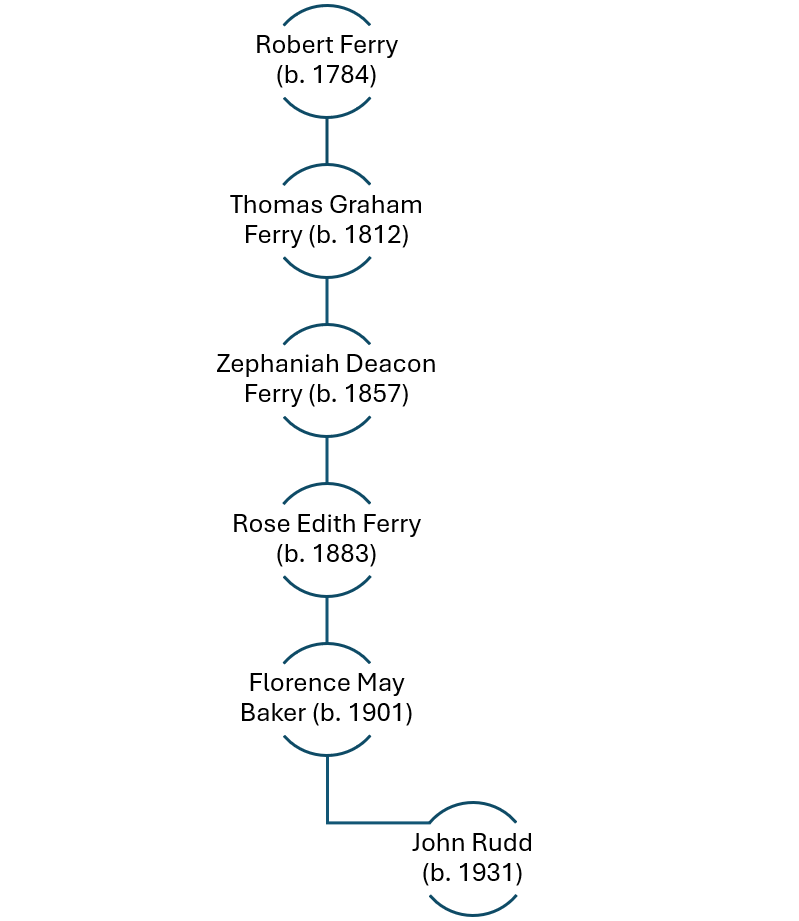
The Ravensworth thread
There is a coda to all this that I cannot quite leave out. My own family moved to this area in the 1990s — almost adjacent to the parish where Robert spent his final years, and where his youngest grandson was born in 1861. And the school house I belonged to was called Ravensworth.
I had no idea, growing up, that the name of my school house belonged to the estate my fifth great-grandfather had gardened for sixty-six years. Family history is full of these quiet echoes — the past reaching forward and tapping you on the shoulder long before you know to look for it. Robert kept Lord Ravensworth's gardens for the better part of a lifetime; more than a century later, without realising it, one of his descendants was wearing the name.
"Much respected," the notice said. I would like to think so.


